





Kiyoshi Suzuki, MD, PhD
President, MOA Health Science Foundation
Spirituality is often defined as a personal and internal connection with a “greater entity” (such as Nature or the fundamental forces of the universe) that does not necessarily belong to a specific religion. However, since many studies address spirituality in conjunction with religion, we will discuss them together here.
Monks and priests have historically been known for their longevity, and people who believe in various religions or spirituality (hereafter collectively referred to as R/S) also tend to be healthy and live long lives. The reason for this is thought to be that R/S influences their lifestyle and behavior, leading them to prefer habits and environments that are beneficial to health. Many people who believe in R/S tend to avoid smoking, excessive drinking, and drug use. They also gain a sense of “meaning in life” through R/S and achieve mental stability through various stress coping mechanisms. Furthermore, healthy eating habits and mutual support among R/S peers are significant factors in maintaining health. Let’s explore to what extent these factors contribute to health.
1.The Significance of Dietary Habits Promoted by R/S
Several religions and sects promote rather strict dietary habits. But are these really beneficial to health? Here are two representative examples:
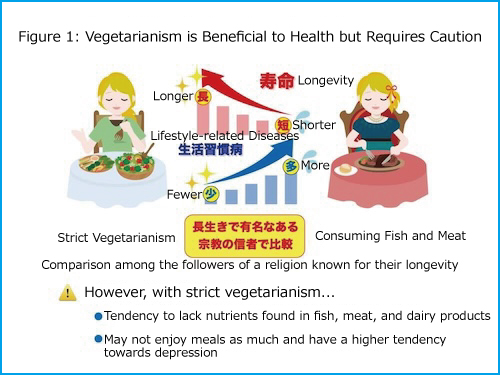 A Christian denomination, based on biblical teachings, encourages strict abstinence from alcohol and adherence to a vegetarian diet. Many of its adherents are known for their longevity. A comparison between strict vegetarians and those who consume fish and meat within this group revealed that vegetarians lived 7 to 10 years longer and had lower incidences of lifestyle-related diseases such as heart disease, diabetes, and cancer (Figure 1, JAMA Intern Med 2013;173:1230-1238).
However, vegetarian diets can be deficient in nutrients commonly found in meat and dairy products, such as vitamin B12, iron, zinc, and protein. Moreover, strictly adhering to a vegetarian diet can sometimes lead to a lack of enjoyment in meals, feelings of guilt when consuming meat, and a higher tendency towards depression (BMJ Nutr Prev Health 2025 Jun 3;8). The physical and mental impacts of a vegetarian diet appear to be more pronounced in men.
Muslim believers observe fasting from sunrise to sunset for one month each year during Ramadan. Moderate fasting has been shown to stabilize blood sugar and cholesterol levels, improve obesity, and be beneficial to health. However, during Ramadan, there are risks of dehydration and nutrient deficiencies, and some people experience stomach issues or weight gain due to excessive eating before and after the fasting period. Health outcomes can also be influenced by surrounding social conditions and healthcare environments, so it cannot be universally stated that everyone benefits from this practice.
While many people strictly adhere to R/S-based vegetarianism or fasting, there is no conclusive data suggesting that these practices are superior to non-religious ones. Based on the principles of the MOA Healthy Food Program, I find the greatest enjoyment in a diet centered on fresh vegetables and rice, complemented with delicious fish and meat, and paired with an appropriate amount of alcohol that suits the meal. I believe that consuming a balanced diet in moderation, while enjoying it, is beneficial to health.
2.Is Participation in R/S Communities Beneficial to Health?
In Column 20, we discussed how the bonds within marriages and local communities promote mental and physical health. But what about the bonds within R/S communities?
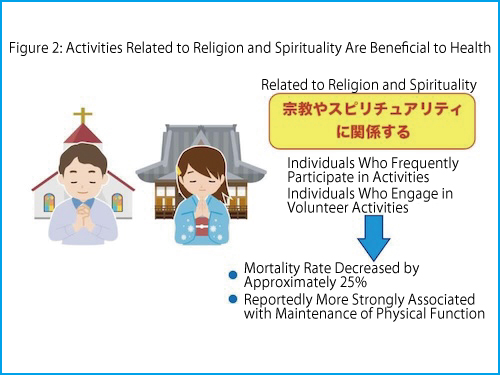 Many studies from the United States on R/S and health reports that individuals who frequently participate in R/S-related activities have higher levels of mental and physical health. Some studies even indicate that the mortality rate decreased by about 25% (Am Psychologist 2003;58:36-52), while others show a significant association with reduced mortality rates in women and fewer hospitalizations in men (Eur J Epidemiol 2023;38:281-289). Additionally, volunteer activities related to R/S were found to have a stronger connection to reduced mortality rates and the maintenance of physical function compared to general volunteer activities (Figure 2, Voluntas 2024;35:97-128).
However, similar trends have not been observed in reports from Japan and Taiwan. It appears that the results vary based on ethnicity, culture, and differences in R/S. Despite this, many research findings suggest that religion and spirituality do promote mental and physical health.
Incidentally, the Lifestyle Care promoted by MOA includes all of the health-promoting elements mentioned above. If a survey was conducted, it might reveal that many MOA members enjoy health and longevity.
Next time, I will discuss the research conducted at Srithanya Hospital, under the direct jurisdiction of the Ministry of Public Health of Thailand, in cooperation with the MOA Thailand Foundation, on the effects of the MOA Arts and Culture Program on depression. Stay tuned.
【Profile】
Kiyoshi Suzuki Graduated from Chiba University School of Medicine in 1981. Doctor of Medicine. After serving as deputy director of pediatrics at Sakakibara Memorial Hospital, working at Seijo Clinic, and director of Tamagawakai MOA Takanawa Clinic and Tokyo Ryôin, he is now chairman of the MOA Health Science Center (foundation) and honorary director of Tokyo Ryôin. Director of the Japan Society for Integrative Medicine and Chairman of the International Committee. In 1994, he was awarded the Young Investigator’s Award by the Japanese Society of Pediatric Cardiology.
